
A Mother’s Faith on Trial: Why the State Must Not Usurp the God-Given Rights of Parents
As a pastor, I have had the profound privilege of dedicating countless children to the Lord and walking alongside parents as they embrace one of life’s most sacred callings. The Bible is clear: it is the God-given responsibility of parents to raise their children in the training and instruction of the Lord. This is not merely a suggestion; it is a divine mandate, a sacred trust given to mothers and fathers to shepherd the hearts and minds of the next generation.
But what happens when that sacred trust is deemed a threat? What happens when a mother reading the Bible to her child is treated not as a fulfillment of her duty, but as a source of harm?
This brings me to a story that should shock the conscience of every Christian family in America. In the state of Maine, a mother named Emily Bickford has been ordered by a court of law to stop taking her 12-year-old daughter to church. She is forbidden from reading the Bible with her. She is, in effect, being penalized by the state for fulfilling her most fundamental duty as a Christian parent.
This is not an exaggeration. The purpose of this post is to unpack the troubling details of this case, to arm you with a clear understanding of the fundamental parental rights that are at stake, and to issue a call for prayer and vigilance. What is happening to the Bickford family in Maine is a direct assault on the principles that undergird both our faith and our freedom, and it is a battle for every Christian home in this nation.
1. The Heart of the Matter: A Christian Mother Penalized for Her Faith
My friends, before we can understand the war, we must understand the battlefield. The specific facts of the Bickford v. Bradeen case are not just legal details; they are the anatomy of an attack on religious freedom. To understand what happened to Emily Bickford is to understand the strategy being deployed against the Christian family.
For three years, Emily and her daughter, Ava, faithfully attended Calvary Chapel. After growing in her faith, young Ava made the personal and beautiful decision to be baptized. But when she shared this exciting news with her father, he was reportedly enraged and initiated legal action.
What followed is something that belongs in a novel about a totalitarian state, not a family court in America. The father’s legal team reportedly brought in a “Marxist former sociology professor” who testified that Bible-believing churches like Calvary Chapel are “cults” that are “psychologically detrimental.” The lower Court accepted this hostile testimony and delivered a finding so chilling it should stop every believer in their tracks. In essence, the judge declared Emily Bickford to be:
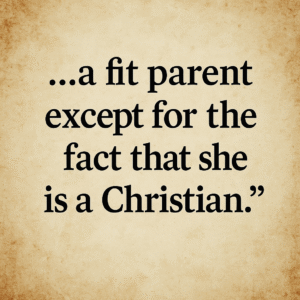
“…a fit parent except for the fact that she is a Christian.”
Let that sink in. A mother’s fitness was not questioned, except for the defining element of her identity and worldview: her faith in Jesus Christ.
The Court’s order was as extreme as its reasoning was flawed. It prohibits Emily from taking Ava to any church without the father’s approval. It is so broad that it could prevent Ava from associating with her friends from church or attending Christian celebrations like Christmas or Easter services. Most shockingly, the order forbids Ava from reading the Bible or any religious literature.
 The impact has been nothing short of devastating. “This has been devastatingly heart-wrenching for both Emily and Ava,” said her attorney, Mat Staver. Emily herself remains hopeful that the Maine Supreme Judicial Court will see the profound injustice of this ruling and overturn what she rightly calls an “unconstitutional” order.
This case is not about two parents who disagree. It is about a court that has allowed itself to become a weapon against faith, violating the most sacred legal and biblical principles that hold our society together.
2. The Bedrock of Our Nation: Parental Rights Are a Sacred and Constitutional Trust
The injustice we see in Maine is not merely an isolated judicial error; it is an assault on a principle that is foundational to both our faith and our nation’s laws. Long before the Constitution was written, the Word of God established that the duty to instruct children in the faith rests with parents, not with kings, governors, or judges. And for over a century, the highest Court in our land has affirmed that this parental right is a cornerstone of American liberty.
Every Christian must understand that this right is not some vague preference but a constitutionally protected fortress.
- A God-Given Mandate: First and foremost, our authority comes from God. He entrusts children to parents, commissioning them to be the primary spiritual guides in the home. The state’s role is to protect this sacred relationship, not usurp it. This means your first duty is to God, and the government is called to honor that, not interfere with it.
- A Fundamental Liberty Interest: The U.S. Supreme Court has long recognized that the right of parents to direct the upbringing and education of their children is a “fundamental liberty interest” protected by the Fourteenth Amendment. In landmark cases like Meyer v. Nebraska (1923) and Pierce v. Society of Sisters (1925), the Court affirmed that the state cannot simply trample on a parent’s right to guide their child’s education and religious instruction. This means your right to raise your child in the faith is not a privilege the government grants you; it is a God-given, constitutionally affirmed freedom the government is forbidden to take away.
- A First Amendment Freedom: Beyond the general right to parent, the Free Exercise Clause explicitly protects a parent’s ability to share their religious doctrines with their child. The government is forbidden from making any law that prohibits the free exercise of religion, including the sacred practice of a mother reading the Bible to her daughter. This means that when you open the Scriptures with your child, you are not just exercising a personal freedom, but a specifically enumerated constitutional right.
Therefore, any action by the government—and a court order is most certainly a government action—that attempts to interfere with this sacred and constitutional right must be held to the highest possible standard of justification. The Court cannot simply have a preference; it must prove an overwhelming and urgent need to intervene.
3. The Government’s High Hurdle: The “Demonstrable Harm” Principle
Of course, the state has a legitimate role in protecting children from abuse and neglect. We thank God for that. But the Constitution builds a high wall to protect the family from unwarranted government intrusion. For a court to breach that wall and override a parent’s fundamental rights, it cannot act on a whim, a bias, or a flimsy accusation. It must meet an exceedingly high legal standard known as Strict Scrutiny.
Under this standard, a court order infringing on parental rights must be justified by a “Compelling State Interest” and be “Narrowly Tailored” to address that interest in the least restrictive way possible.
 Many family courts operate under a vague “Best Interests of the Child” (BIC) standard. However, legal scholars and higher courts have made it clear that the BIC standard alone is not enough to override a constitutional right. Think of the Harm Principle as the Constitution’s steel guardrail. The vague “best interests” standard can swerve all over the road based on a judge’s personal views. Still, it is not allowed to crash through that guardrail and violate a parent’s fundamental rights unless there is proof of severe, demonstrable harm.
Brothers and sisters, the Constitution provides a checklist, and before a judge can interfere in your home, the state must be able to check every single one of these boxes. The harm alleged must be:
- “demonstrable”
- “quantifiable”
- “severe”
- “imminent and substantial.”
The evidence must be objective and concrete, not based on the subjective prejudices of a judge or a so-called “expert.”
Now, let’s look at the “harm” alleged in the Bickford case. According to the reporting, the evidence amounted to claims that the child “at one time was observed to have anxiety,” there was “an observance of a panic attack,” she left “notes around the house,” and saw a “scary demon image” in a workbook.
Is this “imminent and substantial harm”? Is this the kind of severe, demonstrable threat that justifies stripping a fit mother of her constitutional right to share her faith? Of course not. It is a tragically low bar that mocks the high constitutional standard. How, then, could a judge not only accept this but proceed to issue an order that targets the very text of our faith—the Holy Bible?
4. A Robe, Not a Pulpit: Why Courts Cannot Judge the Bible
There is a critical line that no court in the United States is permitted to cross. A court can regulate a person’s harmful conduct, but it has no authority whatsoever to censor the content of their religious beliefs. The state can protect a child from being physically or psychologically abused, but it has no power to sit in judgment on the Bible itself and declare its teachings dangerous.
The central legal truth here is unambiguous: “Judicial orders that ban a parent’s exposure of a child to the Bible per se… are facially unconstitutional.”
Such an order is a direct, content-based restriction on free speech and the free exercise of religion. It is forbidden. The judiciary is, in the words of constitutional experts, “constitutionally barred from acting as a theological arbiter.”
Yet, that is precisely what the lower Court in Maine did. It listened to the biased testimony of one “expert,” weighed the content of the Christian faith, and found it wanting. It passed judgment not on any harmful action by Emily Bickford, but on the very substance of her beliefs.
The Court’s remedy reveals its true intent. A “narrowly tailored” solution to a child’s anxiety might involve counseling or co-parenting classes. This Court, however, used a sledgehammer. It banned the church, it banned Christian fellowship, and it banned the Bible. This was not a surgical intervention to prevent harm; it was a blunt, unconstitutional instrument of religious censorship.
We must be clear: when a court feels empowered to ban the Bible in one home, it has created a dangerous precedent that threatens every Christian home in America.
5. A Cautionary Tale: The Slippery Slope of Judicial Overreach
While the Bickford case is shocking, it is, sadly, not unique. It represents a deeply concerning pattern where courts, operating under the vague and easily manipulated “best interests” standard, can impose their own secular biases against parents with strong, traditional faith.
Consider the case of Burnham v. Burnham in Nebraska. There, the state’s Supreme Court took custody away from a mother based on her “unusual” religious beliefs. The Court did not require any evidence of actual harm, but instead relied on the “speculative ‘adverse impact'” her faith might have on her child. This is the same flawed legal reasoning we see in Maine—a court substituting its own prejudice for the high standard of demonstrable harm, based on flimsy evidence like “anxiety” or a “scary demon image.” Legal scholars have rightly condemned this kind of judicial reasoning, calling it a “flagrant abuse of the courts’ power” that allows judges to substitute their own “personal or societal prejudices” for constitutional law.
This is the slippery slope. The “best interests” standard, when untethered from the high constitutional requirement of demonstrable harm, becomes a tool for social engineering.
This brings us back to the disturbing facts reported in the Bickford case: a father who reportedly found an “ACLU judge” and a “Marxist… professor” to redefine orthodox Christian faith as a psychological threat. This was not a coincidence; it was a strategy. It is the playbook for marginalizing Christianity in the public square by recasting biblical truth as a form of harm.
What, then, must be our response as the people of God?
6. A Call to Prayer and Action for Every Christian Family
The conclusion is inescapable: Emily Bickford is a fit, loving mother whose God-given and constitutionally-protected rights were violated by a court that overstepped its authority and acted as an arbiter of theology. This fight is hers, but it is also ours. Her family is on the front lines of a battle that concerns every believer in this nation. We cannot be silent, and we must not be passive.
As your brother in Christ, I ask you to join me in taking the following steps:
- Pray Fervently. Let us lift Emily and her daughter Ava in prayer. Pray for their strength, their peace, and their endurance. Pray for their legal team at Liberty Counsel, that God would grant them wisdom and favor. Pray for the justices of the Maine Supreme Judicial Court, that their hearts and minds would be opened to the truth and that they would have the courage to uphold the Constitution.
- Stand Firm in Your Own Home. Do not be intimidated. This case should not cause you to shrink back from your duties, but to embrace them with renewed conviction. Be resolute in your God-given responsibility to raise your children in the faith. Teach them the Scriptures, take them to church, and model a life of worship. Your home is your first and most important ministry.
- Be Vigilant in Your Community. We must be watchmen on the wall. Please pay attention to what is happening in our local family courts and on our school boards. These are the places where religious liberty and parental rights are most often challenged. Be informed, be engaged, and be prepared to stand and speak for the truth in love.
In the end, our hope is not in courts or constitutions, but in the sovereign God who ordained the family and who holds all authority in His hands. Let us be a people of faith, not of fear. Let us stand together in prayer and in purpose, trusting that He who called us will be faithful to strengthen us for the challenges ahead.
