

I was standing in the lobby with a cold cup of coffee (because of course I was) when someone asked the question you’re probably thinking: “So… is the church actually coming back, or is this a seasonal glow-up?” Good question.
Over the next few minutes I rambled through headlines, research cues, and the awkward truth that growth and drop-off can sit side-by-side. Attendance is nudging up in places, formation work is not moving fast enough, and digital ministry has finally stopped being a cute side project.
I’ll lean on research indicators (yes, even Barna-style lines) without acting like every chart is prophecy. This article will give you practical moves: what to measure, what to change, and what to quit doing just because “we always have.”
Key Takeaways
- Attendance shows mixed gains but not everywhere.
- Discipleship needs faster, clearer focus.
- Digital work is now essential, not optional.
- Use research smartly—don’t worship the graph.
- Practical next steps: measure, adapt, stop bad habits.
The Future of Church in the United States: The Big Picture for 2026
Look, I don’t have a crystal ball, but the numbers are doing the talking—and they’re a bit contradictory. On one hand, Bible sales are up 41.6% since 2022, spiritual app downloads have jumped 79.5% since 2019, and Christian music streams rose 50% in the same span. That smells like renewed curiosity.
Signs of renewed spiritual openness alongside long-term decline
Those spikes matter. They show people are seeking faith content outside Sunday routines. Yet long-term participation patterns still trend downward in many places. In short: curiosity is rising even while steady practice lags.
Key indicators shaping how churches plan for the year ahead
Practical takeaway for leaders: treat research like dashboard lights. Barna-style tracking shows a 12-point rise in meaningful personal commitment between 2022 and 2025. That’s hopeful—but it’s not a guarantee of regular attendance or discipleship.
- Set quarterly check-ins, not annual panics.
- Swap blanket programs for targeted pathways based on local signals.
- Listen more; assume less.
Small shifts in planning beat dramatic reinventions every time.
What the Data Says About Spiritual Momentum and Declining Christian Practice
Here’s the weird part: the polls are saying people are more committed while habits quietly unravel.
Numbers to hold in your hands: 66% of U.S. adults now say a personal commitment to Jesus remains important — that’s a 12-point rise since the 2021 low. Sounds good, right? But the rest of the spreadsheet refuses to smile.
What “personal commitment” actually signals
Personal commitment in surveys names meaning and identity more than weekly practice. It’s heartfelt, but not synonymous with habits that shape life.
Faith centrality is slipping
Faith centrality among Christians dropped from 74% in 2000 to 54% today. That’s not just less attendance; it’s a formation gap. People can identify as believers without faith organizing their daily decisions.
Non-practicing Christians are a big slice
Nearly half—48%—qualify as non-practicing adults. Only about 24% actively pursue faith rhythms. The discipleship math simply isn’t mathing: more openness, less routine follow-through.
- Commitment rising = opportunity for invitation, not automatic discipleship.
- Faith centrality decline = a call to clearer formation, not shame.
- Non-practicing majority = design pathways that move people from interest to habit.
Practical takeaway: 2026 strategy must hold both signals at once—lean into the momentum while fixing the leaky formation pipeline.
Church Attendance Trends 2026: Young Adults Are Fueling the Comeback
The revival nobody predicted? It’s being led by young adults who actually show up.
Gen Z now averages 1.9 times per month and Millennials sit close at 1.8. That outpaces Gen X and Boomers and marks a real behavioral shift over the last few years.
Gen Z as the most frequent attenders and what that signals
Gen Z attendance has roughly doubled since 2021. This isn’t just nostalgia; it’s a new appetite for community, purpose, and authentic spaces.
Millennials’ rebound and how it differs from older generations
Millennials are rebounding, but their reasons differ. Life-stage moves (kids, jobs, buying homes) shape habits differently than the social drivers pushing younger adults.
Why attendance doesn’t always equal discipleship
Showing up is the first step, not the finish line. You can attend and still be spiritually stuck. That gap matters more than raw numbers.
Practical implications for congregations building next-gen pathways
- Onboard fast: make first visits feel meaningful within weeks.
- Design belonging: small groups and mentoring beat generic volunteer asks.
- Serve with purpose: offer mission-shaped roles, not busywork.
| Age Group | Average Visits / month | Change vs. 2021 | Note |
|---|---|---|---|
| Gen Z (18–24) | 1.9 | ~2× | UK 18–24 rose 4% →16% over eight years |
| Millennials | 1.8 | Up | Life-stage pressures shape different needs |
| Gen X / Boomers | Below 1.8 | Flat / down | More stable identity, less social discovery |
Gender Gaps Are Reshaping Congregations
If attendance were a sport, the scoreboard just flashed a weird stat: men are climbing, women are slipping.
Men’s attendance gains vs. women’s disengagement
As of 2025, 43% of men and 36% of women report weekly attendance. That 7-point gap is the largest in recent years and it shows up in real rooms.
What might be driving the difference
Possible causes include visible leadership paths (or missing ones), a culture that leans into “bro vibes,” and trust issues after high-profile scandals. Add Gen Z patterns: young women report less prayer, Bible time, and service attendance than their male peers.
What leaders should measure right now
Measure before you lecture: track participation, serving roles, small-group membership, and retention by gender and age.
- Run anonymous surveys and focused listening sessions.
- Offer one-on-one conversations with women who stayed and those who left.
- Audit leadership pipelines for clear paths and voice equity.
The stakes are simple: when one group checks out, congregations lose mission and formation—so this becomes everyone’s responsibility, not someone else’s problem.
From Seats to Streets: The Rise of Direct, Bold Evangelism
Evangelism has left the foyer and set up shop on campus sidewalks and short-form video feeds. It’s less about handing someone a bulletin and more about having a real conversation—or filming one.
Why influencer-led and campus-driven outreach is growing
Creators and campus movements are native to platforms where people spend time. They speak in bite-sized moments, show their doubts, and model how to share faith without slipping into sermon-speak.
How local groups can partner without being bypassed
Quick wins:
- Bless and resource students and creators in your seats—give them mic practice and moral support.
- Produce off-stage content: street interviews, Q&A clips, and testimony shorts that point back to local communities.
- Create a clear pathway so individuals who respond online or on campus meet a nearby small group fast.
Here’s the kicker: 80% of non-attenders say they’d come if invited. The old model worked; we just underused it. So partner, don’t panic. If someone with a camera makes a better invite than your bulletin, hire them a coffee and build a follow-up plan.
Sunday Services Are Shifting From Information to Encounter
People can get a sermon anytime; what they can’t download is being known in a room. That flips the weekend equation: content is everywhere, but real connection is rare.
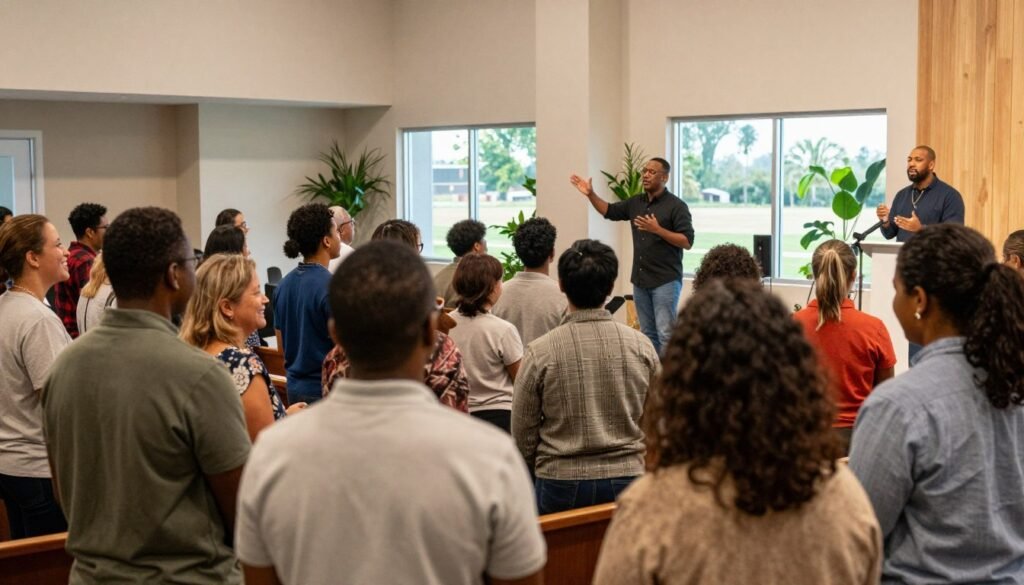
Why content is abundant but community and connection are scarce
The internet serves up talks, clips, and playlists 24/7. Your 35-minute message now competes with a thousand on-demand options.
So the in-person claim can’t be “better content.” It must be something the screen can’t give: mutual presence, honest conversation, and human touch.
Designing gatherings around prayer, presence, and participation
Encounter is simple and practical: expectant prayer, short moments for people to respond, and participatory rhythms that invite action.
- Start with quiet—two minutes of shared prayer or reflection.
- Build space for responses: questions, testimonies, brief table conversations.
- End with next-step invitations that connect people to small groups and local communities.
What this means for preaching, worship, and the in-person value proposition
Pastors should move from information dumps to formation. Tell stories, issue clear invitations, and tie the sermon to Monday life.
Worship should feel owned by the room, not performed at them. Fewer solos, more communal moments, more room to sit with what just happened.
When services prioritize presence, relationships follow. That’s the way a pastor, a team, or any leader helps people leave saying not “Nice talk,” but “Something changed in my life.”
Algorithms Are Discipling Your People More Than You Are
Algorithms are quietly coaching congregants between pew and pillow. Most weeks, your people get far more formation time from feeds than from midweek groups or sermons.
That creates odd realities: two neighbors can sit side-by-side and live in different information bubbles. Fragmented feeds make fragmented formation—values, fears, and priorities diverge even inside the same room.
Culture filters and the “too something” trap
When content platforms amplify extremes, leaders get boxed in. You can be criticized as “too soft” or “too political” before your coffee cools.
Practical digital playbook beyond sermon clips
- Short pastor-to-camera lessons tied to weekly practice.
- Digital small groups with a weekly prompt and accountability.
- Curated formation plans that link online attention to Scripture, prayer, and serving.
Prepare for AI acceleration
AI will multiply content and personalization. That raises more noise and more convincing misinformation. Do a simple time audit: track what shapes you each day and rebalance inputs.
Goal: not to win the internet, but to form resilient disciples who can live faithfully in a noisy world.
ministry trends 2026 church trends 2026”, “Barna trends 2026”, “future of church
Before you rebrand the logo or rip up the calendar, breathe and read the lines properly. Data can give you a pep talk or a panic attack—your call.
How to read Barna-style trendlines without overreacting
Start by separating steady direction from one-off spikes. A 12-point rise in personal commitment and a jump in young adult attendance are real signals.
But don’t build a five-year plan on a single headline. Pair those spikes with sober facts: faith centrality has slipped and nearly half are non-practicing.
Turning research into a churchwide plan for attendance, discipleship, and mission
Pick 3–5 local headline trends that matter. For each, choose responses, assign owners, and set quarterly reviews.
- Gathering: streamline first-visit pathways so new attenders stay.
- Formation: link short digital lessons to weekly small groups.
- Reach: create simple invite loops from online contacts to neighborhood groups.
Balancing hope-filled growth signals with sober indicators of disengagement
Hold both facts at once: yes, commitment and youth attendance are up; yes, practice remains shallow for many. That balance keeps plans honest and hopeful.
Quick caution: overreacting looks like ripping apart programs, chasing one demographic, or making a strategy from one chart. Instead, ask: “What would faithfulness look like here if these data points hold?”
Leadership Trends for 2026: Community-Focused, Team-Based, Transformation-Driven
Let’s be blunt: leadership is getting less heroic and more neighborhood-minded—and that’s a good thing.
Start small. Make your people the primary audience, not just the building on Sundays. When leaders show up where neighbors live, scheduling, messaging, and presence change in simple, obvious ways.
Distributed leadership that prevents burnout
Move away from the lone-everything model. Train clear lanes so collaboration doesn’t become chaos.
Leaders share ownership, reduce single-point stress, and increase buy-in across levels.
Build a bench and simplify systems
Find, train, and trust new people—so one resignation doesn’t cause a panic spiral. Repeatable systems beat complicated genius when volunteer time is tight.
Outcomes over theories
Use KPIs and SMART goals. Define what “win” looks like, measure it, and review without shame. That keeps strategy honest and actionable for church leaders and organizations alike.
- Who you empower: widen the pool, include diverse voices.
- What you measure: retention, next-steps, and leader well-being.
- What you stop carrying: the tasks a dozen people can own together.
Reality check: pastors flourish when they get relational support, role clarity, and mission alignment. Leadership isn’t just structure; it’s personal care for the people who lead.
Conclusion
Let’s strip away the graphs and get to what leaders actually need to do this year.
Bottom line: we’re seeing real spiritual movement and real disengagement at the same time. Your ministry plan must hold that tension without tipping into panic.
Priorities: tighten pathways from attendance to discipleship, rebuild trust and belonging, and take digital formation seriously beyond sermon clips.
Don’t ignore the hard fact that nearly half of adults fit non-practicing patterns—it’s a mission problem, not just a branding headache.
Do this next: pick 2–3 metrics to track, fund one next-gen investment, and commit to one digital shift that actually helps people in life, not just grabs views.
Share this piece with your team, use it as a discussion guide, and start small. The goal isn’t winning a report—it’s helping real people follow Jesus with resilient faith today. Challenges are real, and so is the opportunity.