My Heart on This Issue — A Pastor’s Perspective
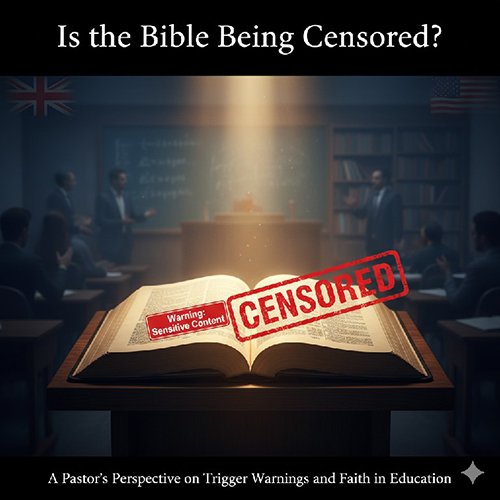
I’m Pastor G, a pastor in the United Pentecostal Church International, and I’ve served the Lord in ministry for over three decades. I’ve taught, preached, and counseled countless families on how Scripture transforms lives. So when I heard that the University of Sheffield in the UK placed trigger warnings on the four Gospels and a story from Genesis — labeling them for “graphic bodily injury and sexual violence” — something stirred deeply in my spirit.
The university said these “content notes” were standard academic tools, designed to prepare students for sensitive topics. But from where I sit, they did more than prepare: they labeled the Word of God as potentially harmful. And that raises alarm bells.
Why This Matters
As a minister, I believe every student — believer or not — deserves true encounter with Scripture, not a warning label that whispers: “Proceed with caution, maybe trauma ahead.” The crucifixion narrative, for example, is a story of love, sacrifice and redemption, not mere “trauma” to be tip-toed around.
Critics in the UK, such as Andrea Williams (Christian Legal Centre), correctly said the trigger warnings were “absurd” and discriminatory. Historians likewise questioned the labeling of the Gospels as containing explicit sexual violence. In situations like this, what starts as “sensitivity” can quickly slide into viewpoint bias — and in practice, censorship.
U.S. Incidents That Raise Serious Concerns
1) Davis School District (Utah) — April–June 2023
Around May 2023, the Davis School District north of Salt Lake City made national headlines when a review committee found the King James Version of the Bible “not age-appropriate” for elementary and middle school libraries because it contained “vulgarity or violence.” According to reporting, the committee concluded the Bible should only remain at high-school levels.
The spark: A parent filed a formal challenge under Utah’s “Sensitive Materials in Schools” law (2022) asserting the Bible contained incest, bestiality, rape, etc. But then the board reversed the decision on June 20, 2023 — unanimously voting to keep the Bible across all grade-levels.
What troubles me: The sequence. The Bible was pulled first (for alleged vulgarity), then reinstated after intense public pressure, legislative scrutiny, and questions about process transparency. To live in a district where a sacred text is put “under review” like secular fiction sends a message: The Bible is uniquely suspect.
2) Keller Independent School District (Texas) — August 2022
In August 2022, Keller ISD sent a mass directive to remove 41 previously challenged titles from libraries before the school year began. These included all versions of the Bible, along with secular works like The Bluest Eye and a graphic adaptation of The Diary of a Young Girl. The removal was ordered despite a prior citizen-committee recommendation that many of those works remain. The timing — immediately at the start of school — means it was less “review” and more “pre-emptive purge.
From my pastoral view: A school district removing the Bible alongside books of very different content — and ordering removal en masse — doesn’t read as neutral. It reads as targeted, or at least poorly thought out.
3) Canyon Independent School District (Texas) — Late 2024
In the Texas Panhandle, under the new House Bill 900 (READER Act) meant to curb “sexually explicit” library materials, Canyon ISD initially removed the Bible — citing that one “instance of sexual content” triggered the ban. Parent groups and state lawmakers (including HB 900’s sponsor) swiftly condemned the move. Representative Jared Patterson wrote: “The Bible … does not contain sexually explicit content as defined by HB 900 … The decision to ban it was likely illegal.”
By December 2024, the district announced the Bible would return to libraries. The troubling part: A law meant to protect students ends up being wielded so broadly that the Bible is excluded until ordered back — a textbook example of over-compliance turning into censorship.
Why This Looks Like Censorship — Especially of the Bible
From my ministry vantage point, three elements stand out:
- Singling out the Bible: In these incidents, the Bible gets treated differently — pulled first, challenged more aggressively, or flagged when other religious texts (or secular challenged titles) are not.
- Procedural opacity: In Davis, for instance, the review committee lacked full transparency, and the reaction from lawmakers underscored how improper the process looked. KUER
- Chilling effect: When students, educators, or parents witness the Bible being treated as “controversial,” it sends an implicit message that Christian faith is suspect in the academic sphere, or must be tamed.
Returning to the UK Example — and My Concern for The Church
When I think of the University of Sheffield’s trigger warnings on the Gospels and Genesis, I see a similar logic at work: a “caution” tag on sacred texts. To me as a pastor, that tag not only prejudges the text but subtly devalues the theological and redemptive dimension of the Bible.
If we as educators or faith-leaders believe the Word of God has power to renew minds, we should resist framing it as a hazard to be avoided. Instead, we should teach with boldness, invite critical but fair engagement, and trust students (and congregants) to wrestle with Scripture — not shrink from it.
My Pastoral Challenge
I challenge fellow ministers, school-board members, librarians and educators:
- Let the Bible be available without a special warning or label that implies it is uniquely dangerous.
- Ensure book-review policies are religiously neutral, transparent, and consistent across all texts — religious or secular.
- Encourage schools and universities to teach the context of difficult passages (violence in the Gospels, distressed psalms, Old Testament narratives) rather than flag them for avoidance.
In 30 years of ministry, I’ve seen the transforming power of Scripture in lives: addictions broken, families healed, hope restored. I refuse to accept an environment where the Bible is implicitly relegated to the “hazardous” shelf in the name of sensitivity.
