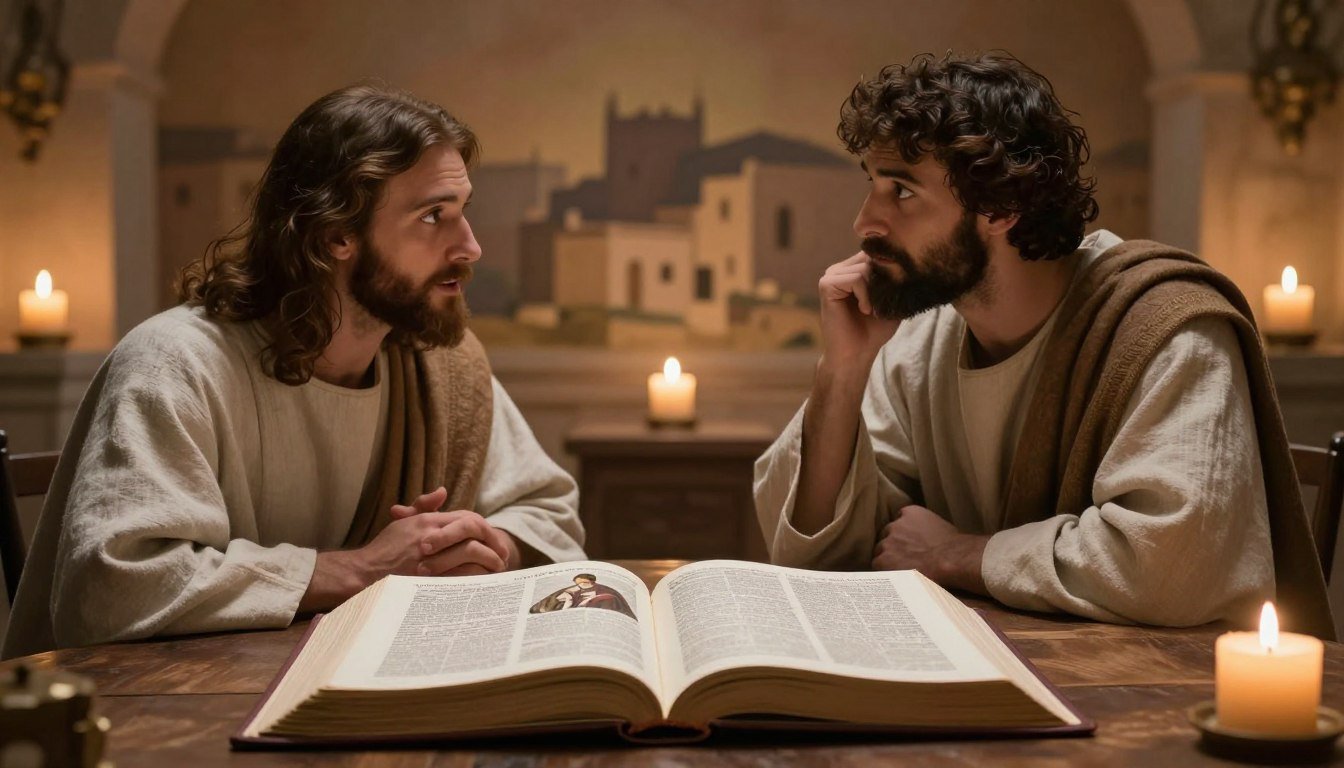
In John 3:5, Jesus says entering God’s kingdom requires a birth God brings about through water-and-Spirit cleansing and renewal, though Christians differ over whether “water” also points to baptism. The phrase “born again, water, spirit” can sound like a puzzle, but Jesus is answering a real question about faith and a fresh start. A short phrase can be easy to carry around and easy to misread, like assembling furniture after glancing at one picture. Scripture interpretation calls for the whole conversation, not a slogan-sized reading. I’ll look at what Jesus said, what the passage may mean, and how Christians connect it with baptism. You can bring honest questions without pretending every detail is settled.
Bring your questions to the whole conversation, not to one phrase pulled out of it.
Key Takeaways
- Jesus describes new birth as God’s work, not a human achievement.
- John 3:3–6 gives the close context for John 3:5.
- Christians differ on whether “water” means baptism, cleansing, natural birth, or more than one image.
- Ezekiel 36:25–27 links clean water, a new heart, and God’s Spirit.
- Acts describes baptism and the Spirit’s work in more than one order.
- Numbers can show activity, but they cannot reveal every person’s faith.
What Do 2025 Baptism Numbers Say About Spiritual Hunger?
Southern Baptist baptism and attendance figures rose in 2025, even as reported membership fell. Those measures tell different stories, so a rise in one does not erase a decline in another.
The figures may point to spiritual hunger, but they cannot tell us each person’s motive. Baptism, weekly attendance, and membership count different kinds of church activity.
Lifeway Research’s 2025 figures show the changes side by side:
| Measure | 2025 figure | Change from 2024 | Careful reading |
|---|---|---|---|
| Baptisms | 263,075 | Up 4.96% | Five straight yearly increases |
| Average weekly attendance | 4,460,910 | Up 3.63% | People attending each week |
| Membership | 12,331,954 | Down more than 3% | Reported members |
The Southern Baptist Convention had five consecutive years of baptism increases through 2025. It was the first such streak in the past 75 years. That longer run gives the one-year change useful context.
A baptism can mark a major step in a person’s Christian faith. A count cannot tell us why each person came forward, what they believe, or how their faith will grow. The numbers are worth noticing, but they are not a window into every heart.
Treat baptisms, attendance, and membership as different measures, not interchangeable totals.
Three reading checks can keep the numbers in their proper lanes:
- Identify what each measure counts.
- Keep baptism, attendance, and membership distinct.
- Notice whether the comparison covers one year or a longer run.
Rising baptisms can be an encouraging sign of spiritual interest. They do not, by themselves, settle what is happening in every church or in every person’s life.
A church can welcome new people while losing members for other reasons. Attendance can rise without matching growth in membership, since the measures describe different groups. The numbers are a snapshot, not a full account of spiritual life.
When you read a report, check its time frame before drawing a large conclusion. A five-year pattern means something different from one strong year.
Who Was Nicodemus, and Why Did He Come at Night?
Nicodemus came to Jesus with the kind of résumé that might make a person assume he already had the spiritual basics handled. John gives him real standing, then places him in a conversation where status cannot answer everything.
John 3:1–5 is the Nicodemus passage about being born of water and Spirit. His nighttime visit sets the scene for a serious question, not a joke about someone missing an obvious point.
The credentials Nicodemus brought
John describes Nicodemus as a Pharisee and a member of the Jewish ruling council. He was a teacher with religious knowledge and public standing. He did not arrive as a person unfamiliar with Scripture or religious life.
The night setting may suggest caution, privacy, or simply the time he chose to speak. John does not explain his reason. The scene is quiet and focused, with no crowd to turn the exchange into a public debate.
His title mattered, but Jesus did not treat it as a substitute for understanding. A respected teacher can still have a question that reaches beyond what credentials can settle. That is not an insult to the teacher; it is a reminder that learning keeps going.
The question he could not sidestep
Nicodemus hears Jesus speak about being born again and asks whether a person can enter his mother’s womb a second time and be born. The question takes the words in a physical sense. It gives Jesus a clear opening to explain the kind of birth he means.
Jesus is not asking Nicodemus to repeat his first birth. He is pointing to a new beginning that ordinary human effort cannot produce. The contrast matters because the teacher’s question makes the gap between physical birth and spiritual birth plain.
Nicodemus’s words may sound literal to modern ears, but John presents them as part of a real exchange. The teacher is trying to make sense of language that does not fit his first frame of reference. Most of us have had a moment when a sentence refuses to fit the box we brought.
John does not portray Nicodemus as foolish. He shows a man willing to approach Jesus, listen, and ask what the words mean. His question is not a punchline; it puts the need for a new beginning right on the table.
What Did Jesus Mean by “You Must Be Born Again”?
Jesus is telling Nicodemus that religious standing cannot substitute for a new life that comes from God. Born again can also mean “born from above,” a phrase that points to where this life begins.
John 3:3 and 3:5 describe seeing and entering God’s kingdom through this new birth. John 3:5 says a person must be born of water and the Spirit to enter the kingdom of God.
Regeneration means God’s work of giving a person spiritual life and renewal. It is not a religious badge or a prize for collecting enough good behavior. The new birth begins with God’s action.
John 3:6 contrasts what is born of flesh with what is born of the Spirit. Flesh refers to ordinary human birth, while the Spirit gives the life Jesus describes. A polished public image cannot create that inward renewal.
Nicodemus had religious knowledge, yet Jesus told him he needed this new beginning. That does not make study or good choices worthless. It means neither can replace the life given by God.
The phrase “must be born again” is not a demand to perform a second physical birth. It names a need that no person can meet by effort alone. Christians may explain some details differently, but Jesus’s central point is clear: life in God’s kingdom depends on God’s work.
The passage also refuses to reduce faith to a set of credentials. A title, family background, or long record of religious activity cannot make a person spiritually alive. In John’s account, the contrast is between human birth and birth from the Spirit.
That is why the new birth matters to someone asking about a fresh start. Jesus speaks of a life with a changed source, not a better version of the same old self. The point is a changed origin and life, not a second trip through the delivery room.
Born Again Water Spirit: What Does John 3:5 Mean?
John 3:5 restates Jesus’s point in John 3:3: entering God’s kingdom requires the new birth he has just told Nicodemus about. The two verses belong together, even though Christians do not all explain their wording in the same way.
The water-and-Spirit language describes cleansing and spiritual renewal, not a person earning entry through religious performance. John 3:3 says no one can see the kingdom unless born again; John 3:5 says no one can enter it unless born of water and the Spirit.
https://www.youtube.com/watch?v=0QBkbycXtP0
In plain language, “born of water and the Spirit” means the birth God gives, with cleansing and renewed life. The phrase born of water and the Spirit appears in John 3:5, where Jesus answers Nicodemus’s question about a second physical birth.
John’s wording links the new birth in verse 3 with birth of water and Spirit in verse 5. Many Christians read the verses as two descriptions of one birth. Others give “water” a distinct role, so it is wise not to pretend every tradition reads the phrase identically.
John 3:6 follows with a contrast between flesh and Spirit. That next line supports reading the exchange as a whole rather than making one word carry the entire meaning. The surrounding words matter, even when one phrase catches our eye.
Nothing in this passage suggests that a person can buy entry with religious activity. Jesus describes a birth that God brings about. Christians may connect that birth with baptism in different ways, but the text emphasizes the life God gives.
If you are reading John 3:5 for the first time, keep Nicodemus’s question in view. He has heard a claim about new birth and is trying to picture it as physical birth. Jesus’s answer shifts the conversation toward a birth that comes from above.
Read the words beside John 3:3 and 3:6 before deciding what one phrase can carry.
Does “Water” Mean Natural Birth, Baptism, or Cleansing?
Christians have read “water” in John 3:5 in more than one way, and baptism is one important interpretation. No single reading is accepted by everyone, so the question deserves a fair look rather than a quick verdict.
Christians do interpret “water” as baptism, but natural birth and spiritual cleansing are also discussed. The meaning of born of water should be considered in John 3’s context, not settled by one word alone.
| Interpretation | What “water” means | Biblical or contextual support | Caution |
|---|---|---|---|
| Natural birth | Amniotic fluid at birth | Connects water with physical birth | One possible reading, not the preferred view in one scholarly discussion |
| Baptism | Water baptism | Common reading in Christian interpretation | Not a settled view across all traditions |
| Cleansing or spiritual renewal | God’s cleansing and renewal | Connected with Ezekiel 36:25–27 | Does not end every debate about the phrase |
The natural-birth proposal connects water with the fluid around a baby before birth. One scholarly article discusses that view but does not favor it. It remains a possible reading, not a fact every reader must accept.
Baptism is a common interpretation, and many Christians connect John 3:5 with water baptism. Other Christians understand the water as an image of cleansing, especially alongside the promise in Ezekiel. These readings share an interest in what God does, but they do not assign the water the same role.
John 4:2 says Jesus himself did not baptize people, though his disciples did. That detail helps describe Jesus’s ministry, but it does not settle what he meant in John 3:5. A single nearby detail should not be asked to do more work than it can.
The debate is not a reason to ignore the passage. It is a reason to read the surrounding words and notice how each interpretation accounts for them. Christians can take the verse seriously while admitting that they differ.
When you hear the phrase born water spirit, remember that it points to a passage with more than one long-held reading. You can learn what your church teaches without assuming every Christian shares that view. Present the options honestly, then let the passage’s context do its work.
How Does Ezekiel 36 Help Explain the Phrase?
Ezekiel gives Nicodemus a scriptural backdrop for hearing water and Spirit as images of God’s cleansing and renewal. The promise joins both images rather than treating clean water and the Spirit as unrelated.
Ezekiel 36:25–27 links clean water, a new heart, and God’s Spirit within his people. The passage describes God cleansing people from impurity and idolatry, then giving them an inner change.
The promise is not about people scrubbing themselves into a better standing. God says he will cleanse them, give them a new heart, and place his Spirit within them. That makes the passage a strong backdrop for the water-and-Spirit language in John.
Ezekiel 36:25–27 identifies the passage linking clean water and the Spirit in ordinary biblical language. Its promise has three connected parts:
- Cleansing: God washes away impurity and idolatry.
- Inner transformation: God gives a new heart and spirit.
- Spirit-enabled change: God puts his Spirit within his people.
The phrase “give heart flesh” points to the promised heart of flesh, which replaces a heart described as stone. The image is not about a person becoming perfect overnight. It shows a new inner direction made possible by God.
That connection helps explain why Christians may read water and Spirit together as one new birth with cleansing and renewal. It does not prove that every reader must interpret John 3:5 in exactly the same way. A strong connection can guide reading without ending every disagreement.
Ezekiel’s promise also helps keep the focus on God’s action. The person receives cleansing and a new heart; the person does not manufacture either one. That difference matters when we talk about spiritual life and change.
In this reading, the new beginning depends on what God promises to do, not on a person repainting the old life.
What Does the Wind in John 3:8 Add?
Jesus’s wind image makes the new birth feel less like a button we press and more like a work God brings about. The image stresses freedom: people can hear the wind, but they cannot direct its path.
John 3:8 uses the same Greek word for “wind” and “Spirit.” Jesus uses that wordplay to show that the Spirit’s work is real, even when people cannot control or map it.

Wind moves through a place without asking our permission. We can notice its sound and effects, but we cannot order it to follow a route. Jesus uses that familiar experience to describe the Spirit’s work in a person.
The point is not that the Spirit acts at random or without purpose. Rather, human beings do not manage God’s work like a household switch. New life comes from God, not from a technique we master.
John 7:38–39 also connects Jesus’s living-water image with the Spirit. That link adds a useful note to the Gospel’s images of water and life. Still, images work within their own passages; one mention of water does not automatically mean the same thing everywhere.
John’s word choice makes the wind image memorable without turning it into a secret code. The comparison helps Nicodemus understand why spiritual birth cannot be reduced to physical processes. A person can see what the wind does without claiming to own it.
That is a helpful limit for any talk about spiritual renewal. We can describe what Jesus says and how the passage uses its images. We should not turn the image into a method for controlling the Spirit.
The image points to the Spirit’s freedom, not to a technique for summoning him.
What Happened When the Spirit Came at Pentecost?
Acts 2 shows the Spirit’s arrival becoming a public event that people could hear and respond to. The story includes a sign, a message, and a crowd, each with its own place in the account.
The account describes about 3,000 people responding to Peter’s message and receiving baptism that day. Acts presents this event as a moment in the early church’s life, not a template that every conversion must copy.
| Moment | Passage | What happens |
|---|---|---|
| The Pentecost gathering | Acts 2:1–3 | The disciples are gathered when the event begins |
| Spirit-enabled tongues and listeners hearing their own languages | Acts 2:4–11 | People speak in other tongues, and listeners hear their languages |
| The response to Peter’s message | Acts 2:41 | About 3,000 people accept the message and are baptized |
At Pentecost, the Spirit enabled people to speak in other tongues. Listeners from different places heard them speaking in their own languages. The event made the Spirit’s arrival public, not private or hidden from the gathered crowd.
Peter then spoke to the people about Jesus. Acts says about 3,000 accepted his message and were baptized that day. The account gives both a public message and a large response.
A large number does not tell us everything about each person’s long-term spiritual life. The story records a striking day, not a report on every later choice or belief. A crowd can respond sincerely without its size becoming a measure of each person’s future.
Acts also does not say that every Christian will experience the same signs in the same order. The story gives us a particular event and its meaning in that moment. We can honor its details without turning them into a rule the passage does not state.
Keep the miraculous sign, the preached message, and the crowd’s response distinct.
What Is the Apostles’ Pattern in Acts 2:38?
Peter’s answer in Acts 2:38 names repentance, baptism in Jesus Christ’s name, forgiveness of sins, and the promised gift of the Holy Spirit. Those parts belong in the verse, even as Christians debate how its pattern applies across the New Testament.
Peter directly tells the crowd to repent and be baptized in Jesus Christ’s name. He connects that instruction with forgiveness and the gift of the Holy Spirit.
Repentance and baptism in Jesus’ name
Repentance means turning from sin toward God. Peter calls the crowd to respond to the message about Jesus, not simply to agree with an idea. Baptism is part of his direct instruction to those listeners.
Acts 2:38 has shaped Christian teaching about faith and water baptism for centuries. Churches differ on how baptism relates to forgiveness and the new birth. The verse should be read carefully, not trimmed to say only what a reader already expects.
Peter’s words address the people gathered before him. Their response follows his message about Jesus. That setting matters when Christians ask how the account relates to other passages and experiences.
The promised gift and the tongues question
Peter also promises the gift of the Holy Spirit. Some Bible translations use the traditional wording “Holy Ghost,” while this article uses “Holy Spirit.” The terms refer to the same person, not two different beings.
Tongues appear in the Pentecost account, but Christians do not all agree that speaking in tongues is required proof of new birth. One event in Acts should not become an uncontested rule for every Christian. Churches read the wider New Testament in different ways.
Acts 8 describes people being baptized before they receive the Holy Spirit. Acts 19 describes baptism, then the Spirit coming upon people, followed by speaking in tongues. The order and details differ, so Acts does not present one simple sequence in every story.
These accounts invite careful reading rather than a contest over whose experience counts. The passages give specific details about specific groups. A church may teach a clear view, but Christians should know where the text ends and their interpretation begins.
Let the passage say what it says without making its sequence answer every denominational question.
Does Water Baptism Automatically Prove New Birth?
Water baptism matters in Christian teaching, but the act by itself should not be treated as a universal receipt for inward renewal. The outward act and inner life are related, yet Christians explain that relation in different ways.
Christian traditions differ on how baptism relates to regeneration, and Acts 10:44–48 describes the Spirit coming before water baptism. That passage keeps us from claiming that every biblical account follows one fixed order.
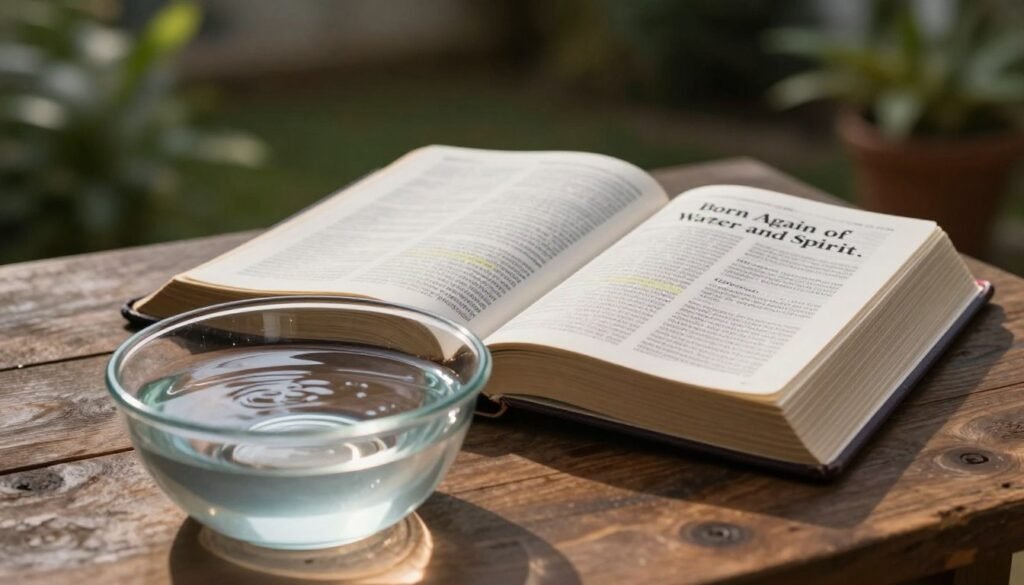
In Acts 10:44–48, the Holy Spirit comes upon the listeners before they receive water baptism. Peter then orders baptism. The account treats both the Spirit’s work and baptism as serious parts of the event.
Titus 3:5 connects washing and renewal with the Holy Spirit. Christians read that language in different ways, especially when they ask how it relates to baptism. The verse points to God as the source of renewal without erasing those differences.
A person’s baptism can be a meaningful public act of faith. It can mark belonging to a Christian community and a response to Jesus. Still, no observer can measure another person’s heart by watching one outward act.
A three-point checklist can help you read claims about baptism:
- Distinguish the sign from the inner renewal it signifies.
- Read the full passage rather than one clause.
- Ask how a church tradition understands baptism.
These checks do not make baptism unimportant. They help keep the question fair when Christians use the same word but explain its role differently. A careful answer can honor the practice without pretending the debate has vanished.
A thoughtful answer keeps baptism meaningful while refusing to measure another person’s heart by a single outward act.
Can a Crowd Prove Revival Today?
No: a crowd can show increased participation, but numbers alone cannot establish revival. Participation is visible; a person’s lasting faith and inner change are harder to count.
In a 2023–24 survey, 62% of U.S. adults identified as Christians. The share identifying as Christian stayed between 60% and 64% from 2019 to 2024.
The survey measure covers U.S. adults who identify as Christian. That answer is not the same as weekly attendance, baptism, conversion, or sustained spiritual renewal. Each measure describes something different.
A crowd may show that more people took part in a service or event. A rising count can be encouraging, but it cannot tell us what each person believes or how their life will change. Numbers are useful, just not magical truth detectors.
The share of adults who identify as Christian can remain steady while local churches see different patterns. A national figure does not show every town, congregation, or individual experience. Its value depends on asking the right question.
A steady share of Christian identification is not a count of conversions or transformed lives.
It’s Not Too Late to Start Over
Nicodemus did not stay only in the shadows of John 3; later, he spoke up and showed care for Jesus. John records actions, though it does not give a complete account of his inner faith.
His later choices show courage and care without proving every detail of his beliefs. That leaves room for hope and honest questions, without claiming more than the text says.
Nicodemus moves from night to public risk
In John 7:50–52, Nicodemus asks the council whether the law judges a person before hearing him. He speaks up as the group discusses Jesus. It is a public act, even though John does not spell out all his motives.
At Jesus’s burial, Nicodemus brings a mixture of myrrh and aloes weighing about 75 pounds, as John 19:39 records. The gift shows care and carries real weight—quite literally. John still does not state a full conversion story.
Those scenes show a man whose actions change over time. John gives us more than one moment, but not a complete account of every thought Nicodemus held. We can honor what the text says without filling its silence with guesses.
A small, honest start
If you want a new beginning, you can speak plainly to God about what troubles you. You don’t need to dress up a question as a speech or pretend certainty you don’t feel. Honest words are a good place to begin.
Lamentations 3:22–23 says God’s compassions are new every morning. That image offers hope for people who need another day and another chance to seek God. A fresh start does not require you to pretend yesterday never happened.
Three next steps can make the first move more concrete:
- Tell God plainly what you are struggling with.
- Ask for help rather than pretending you’re certain.
- Talk with a trusted pastor or mature Christian.
Asking for help is not a failure of faith; it is an honest step toward understanding.
If baptism or faith feels confusing, a trusted Christian can read the passage with you and explain how their church understands it. You can ask questions without making a promise you do not understand. A careful conversation is better than a rushed answer that leaves you more tangled.
John leaves the full story of Nicodemus’s faith unstated, but his later actions show courage and care.
Conclusion
You don’t have to pretend every part of John 3:5 is settled in your mind before you take Jesus’s invitation seriously. Jesus describes a new beginning that God gives, and honest questions belong in that conversation.
The passage connects cleansing and renewal with life from the Spirit. Christians may differ on how water relates to baptism, but you can read the full exchange and seek help as you consider its meaning.
Write down one question you still have about John 3:5 and bring it to someone who will read the passage with you.