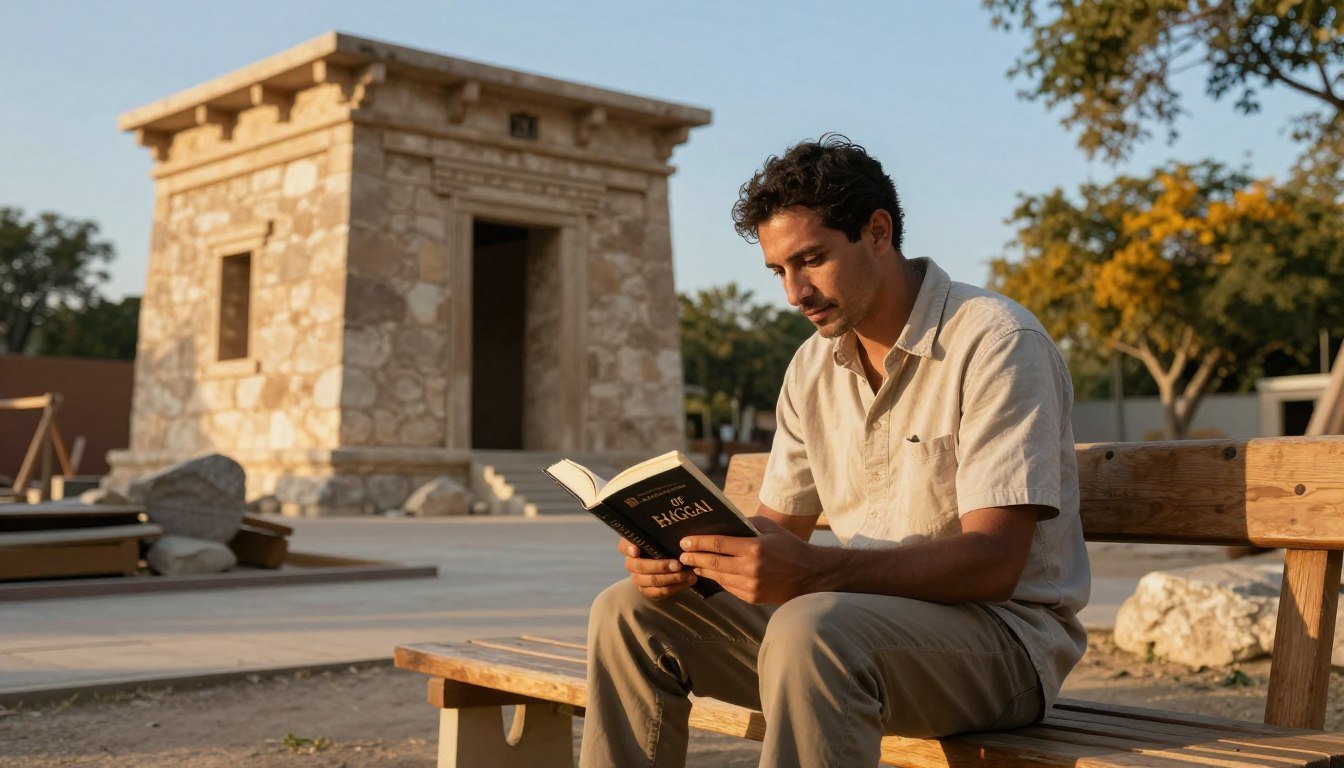
A poll can describe how people feel about the future, but it cannot tell us what God will do. Hope in Haggai 2:9 rests on God’s presence, not a prediction about America. The American mood may be gloomy, but discouragement cannot see every road ahead.
It is easy to look back at an era and imagine everyone had better hair, better manners, and fewer alarming headlines. That memory may hold real good, but it cannot settle what comes next. A national outlook is not a prophecy.
This story connects today’s unease with a community rebuilding its temple after loss. It offers Christian hope without promising that America’s future will match anyone’s favorite picture of the past. Shalom is a Hebrew word that can mean peace as well as well-being and prosperity.
Haggai’s first answer to discouraged builders was not “your project looks impressive,” but “I am with you.”
Key Takeaways
- A poll captures a mood, not God’s plan.
- Ezra describes grief and joy at the same temple foundation.
- Haggai grounds courage in God’s presence.
- Christian hope rests on Christ’s work, not perfect circumstances.
- One faithful task can be a good place to begin.
A Nation Turns 250, Yet Many Feel Gloomy
In December 2025, more surveyed U.S. adults said the country’s best years were behind it than said they were ahead. That feeling was common, but it does not tell us what the next chapter will bring.
In a survey of 3,560 U.S. adults conducted December 8-14, 2025, 59% said America’s best days were behind it. Forty percent said the country’s best years were ahead.
| Measure | Response | Share | Survey dates |
|---|---|---|---|
| Country’s best years | Behind | 59% | Dec. 8-14, 2025 |
| Country’s best years | Ahead | 40% | Dec. 8-14, 2025 |
| Country in 50 years | Pessimistic | 44% | Dec. 8-14, 2025 |
| Country in 50 years | Optimistic | 28% | Dec. 8-14, 2025 |
Another 27% felt neither optimistic nor pessimistic about the nation 50 years later. Those answers leave room for uncertainty, not just cheer or gloom.
The Pew Research Center survey findings also show differences among groups. Sixty-four percent of Democrats and Democratic leaners said the best years were behind, compared with 53% of Republicans and Republican leaners.
Sixty-one percent of lower-income adults and 61% of middle-income adults felt the same way. Upper-income adults were evenly split. No one group’s answer speaks for every person in America.
A national mood is a snapshot of people’s feelings, not a prophecy about what will happen.
People can feel worried about the nation and still long for hope in their own lives. Treat these percentages as a snapshot of people’s feelings in December 2025, not a verdict on the next 50 years.
What the 2026 Mood Polls Can and Cannot Tell Us
In April 2026, dissatisfaction with the country’s direction was common, but more than half of adults still said they felt happy when thinking about the days ahead. Those feelings can coexist because they answer different questions.
A survey conducted April 6-12, 2026, found that 69% were dissatisfied with how things were going in the country. Twenty-nine percent were satisfied. The responses describe distinct parts of the public mood.
| April 2026 measure | Response | Share | Survey dates |
|---|---|---|---|
| How things were going | Dissatisfied | 69% | Apr. 6-12, 2026 |
| How things were going | Satisfied | 29% | Apr. 6-12, 2026 |
| Country’s future | Pessimistic | 51% | Apr. 6-12, 2026 |
| Country’s future | Optimistic | 48% | Apr. 6-12, 2026 |
| Days to come | Happy | 54% | Apr. 6-12, 2026 |
Thinking about the country’s future, 51% felt pessimistic, and 48% felt optimistic. A separate question found that 54% felt happy when thinking about the days to come.
The April 2026 survey results capture those answers at one point in time. They do not ask the same thing as the December 2025 questions about America’s best years.
Someone can dislike the nation’s direction and still feel glad about family, plans, or a new day. Sixty-nine percent dissatisfied and 54% happy are not contradictory answers to one question.
People can carry hope in one part of life while feeling concern about another. A mixed mood can be honest without becoming a forecast of what God will do.
Shouting and Weeping at the Foundation
At the foundation ceremony, the loudest sound was not pure celebration or pure grief, but both at once. Ezra 3:12 describes older priests, Levites, and family heads weeping loudly while many others shouted for joy.
The older witnesses had seen Solomon’s Temple, the first temple in Jerusalem. They remembered what had been lost. Many others saw a beginning worth celebrating, even if the new work could not erase the past.
- Older people grieved for the first temple they remembered.
- Many others shouted with joy at the new beginning.
- The two sounds blended and carried across the crowd.
Grief at a new beginning does not prove that beginning has no value. The people could mourn what stood before and still take part in building something new.
That scene makes room for people whose feelings do not line up neatly. You can be glad that a door has opened and sad about the room you left behind.
Let the mixed reaction in Ezra 3 remind you that joy and mourning can occupy the same moment.
What Happened to the First and Second Temples?
The “Second Temple” is a name with two uses, which is why the timeline can feel like a history quiz written by a trickster. The names mark related stages of the temple in Jerusalem, not three wholly separate buildings.
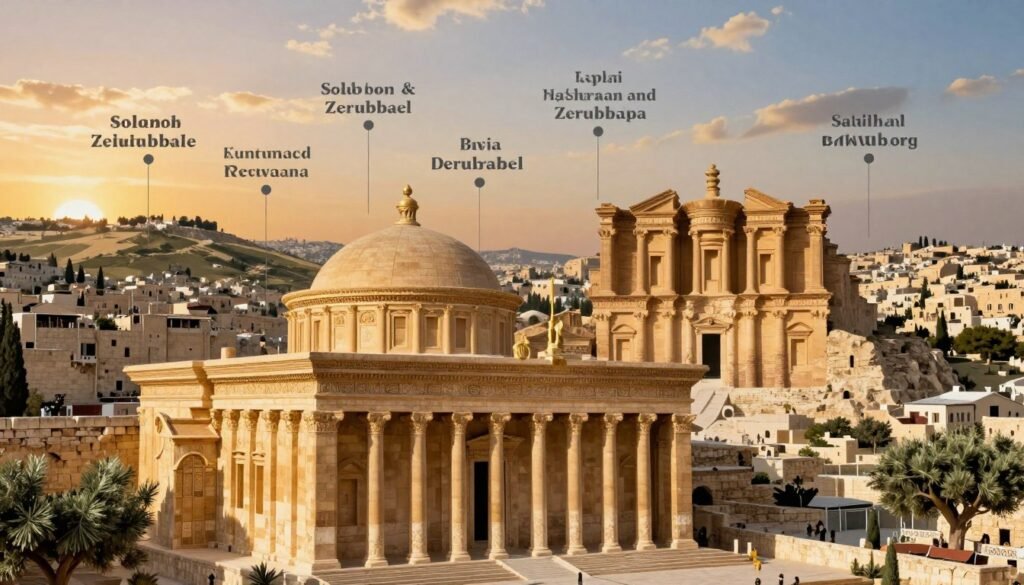
Zerubbabel’s Temple was rededicated around 515 B.C. Herod later rebuilt that temple complex, and both stages can be called the Second Temple.
From Solomon’s Temple to Zerubbabel’s Temple
The Babylonians destroyed the first temple, Solomon’s Temple, around 586 B.C. After the exiles returned, the community rebuilt the temple and dedicated it around 515 B.C.
| Temple event | Date | Who was involved | What happened |
|---|---|---|---|
| Solomon’s Temple destroyed | Around 586 B.C. | Babylonians | First Temple destroyed |
| Rebuilding begins | After the return | Returned exiles | New temple built |
| Zerubbabel’s Temple rededicated | Around 515 B.C. | Returning community | Temple dedicated |
| Herod begins rebuilding | Around 20 B.C. | Herod | Temple complex rebuilt |
Herod’s Temple and the Shared Name
Herod began rebuilding around 20 B.C. The project was not completed until around A.D. 63, and Roman forces destroyed the Second Temple during the siege of Jerusalem in A.D. 70.
Herod’s Temple was a rebuilding of the Second Temple, not a wholly separate “third temple” in this naming convention. The shared name can refer to Zerubbabel’s Temple or the later complex.
Jewish rabbinic tradition remembered five things missing from the Second Temple: the sacred fire, the Shekinah, the ark and cherubim, the Urim and Thummim, and the spirit of prophecy.
The names describe different stages of the same temple story. Keep the distinction straight: Zerubbabel’s Temple was rededicated around 515 B.C.; Herod later rebuilt that temple complex.
The Setting Behind Haggai’s Encouragement
Haggai’s encouragement arrived while the community was still rebuilding, on the twenty-first day of the seventh month in 520 B.C. The work was unfinished, and the people needed more than a polished building plan.
Haggai addressed Zerubbabel, Joshua the high priest, and the people of the land. His message came during the seven-day Feast of Tabernacles, on the twenty-first day of the seventh month.
The prophet spoke to a rebuilding community, not to a comfortable audience admiring a completed project. The leaders and neighbors had to keep working while the result was still taking shape.
- Haggai was the prophet.
- Zerubbabel was the governor.
- Joshua was the high priest.
The date places Haggai’s words inside an active season of worship and work. That setting matters: the message met the people in the middle of their task, not after every worry had vanished.
Remember the setting: a real community, led by Zerubbabel and Joshua, trying to keep building amid discouragement.
God Speaks to Discouragement in Haggai 2
Haggai’s answer to a discouraged building crew was a command to be strong and work, backed by the promise that God was with them. The message joins courage to action, rather than waiting for the project to feel easy.
Haggai 2:4-5 speaks to Zerubbabel, Joshua the high priest, and the people of the land. The call reaches leaders and the whole community.
Strength for the Leaders and the People
Haggai repeats the call to be strong for the governor, the high priest, and the people. He does not reserve courage for those with titles or for those who already feel brave.
- Be strong.
- Work.
- Do not fear.
Work Rooted in God’s Presence
The reason for this command is God’s promise: “I am with you.” Haggai also tells the community that God’s Spirit remains among them.
That promise does not say the building will look impressive right away. It says the people can keep working because they are not carrying the task alone.
Haggai’s encouragement is a reason to continue, not a claim that the result will look grand at once. The people had a command, a promise, and work still to do.
For these builders, courage did not mean feeling fearless; it meant continuing the work with God’s presence as their reason.
Hope in Haggai 2:9: The Glory of the Latter House
Haggai 2:9 promises greater glory, but its Hebrew wording allows two ways to identify what “former” and “latter” are being compared with. The promise looks forward, though readers differ on the comparison.
The verse says the latter glory of the house will be greater than the former, and God will give peace in that place. The Hebrew wording does not require only one reading.
Two Ways to Read “Greater Glory”
| Reading | What “latter” is compared with | What the promise means |
|---|---|---|
| Greater than Solomon’s Temple | The former temple | The later house has greater glory |
| Greater than its current state | The building in Haggai’s time | Its future glory will exceed its present state |
| Shared point | The present and future | God promises future glory |
The Promise Looks Beyond What They Could See
One reading compares the new temple with Solomon’s Temple. Another compares the future splendor with the building’s condition when Haggai spoke.
Both readings direct attention past what the builders could see that day. A modest project and a difficult season did not define its future.
Haggai’s promise of future glory offers hope without turning the building’s appearance into a measure of God’s care. A person can trust the promise without claiming certainty about one translation.
The common thread is not a flattering review of the building; it is God’s promise that its present appearance is not the last word.
Peace Means More Than Quiet
In Haggai 2:9, the promised peace means more than a room where nobody is arguing. Shalom is a Hebrew word that can mean peace as well as well-being and prosperity.
The verse says God will give peace in “this place.” God is the giver, and the temple is the setting named in the promise.
Peace can include more than the end of conflict. It can point to life made whole, with well-being and prosperity as part of the meaning.
That promise does not mean every individual will have an easy life. The Bible does not present faithful people as immune to loss, illness, or hard days.
Haggai’s words tell the people what God promises for that place; they do not offer a simple formula for every personal circumstance. Read “peace” as God’s promised well-being, not as a promise that faithful people will never face trouble.
Jesus and the Second Temple’s Greater Glory
The Christian answer to how a less impressive temple could have greater glory is that Jesus was present there. In this reading, divine presence matters more than silver, gold, or the building’s scale.
Luke 2 places Simeon and Anna at the temple as they wait for the Messiah. The scene gives Christian readers a way to understand the temple’s glory through the person who entered it.
This is a Christian theological reading of Haggai’s promise, not a view shared by every interpreter. It does not claim that the building itself was more lavish than Solomon’s Temple.
Architecture can impress the eye, but this interpretation points to a deeper source of glory. The value lies in God’s presence among the people, not in a contest over size or shine.
The temple setting in Luke gives that reading a human face. Simeon and Anna’s long wait meets the child they recognize as the Messiah.
In this reading, the glory came from who entered the temple, not from a renovation budget.
A Promise, Not a Guarantee of Easy Days
Haggai promises God’s faithfulness through upheaval, not a life with the difficulty settings turned permanently to “easy.” Hope is not a forecast that every part of life will improve on schedule.
Haggai’s message spoke to a particular rebuilding community. It also uses images of God shaking the heavens, earth, and nations.
Neither Haggai nor Hebrews gives permission to predict America’s political future. Their words also do not promise that every believer’s personal circumstances will steadily improve.
Hebrews 12 uses the image of shaking too, then directs attention to what cannot be shaken. The focus is on trusting God through change, not on a promise that change will always feel kind.
A hard year does not prove that God has left, and a hopeful verse does not make pain unreal. Let the promise give you confidence in God without turning it into a forecast about your next year.
Hebrews 9 and the Hope of a Cleansed Conscience
Hebrews 9 locates lasting hope in Christ’s completed work, not in a person’s ability to fix everything by sheer force of will. Christian hope begins with what Christ has done.
Hebrews says Christ entered the Most Holy Place once for all by his own blood, obtaining eternal redemption. His work is presented as complete, not something people must earn.
Christ’s Once-for-All Work
Hebrews 9:14 says Christ’s blood cleanses consciences from acts that lead to death. The result is a life that can serve the living God.
A cleansed conscience does not mean a person never remembers a wrong choice. It means that shame does not have to be the final word over someone who turns to Christ.
A New Covenant and a Lasting Inheritance
Hebrews 9:15 calls Christ the mediator of a new covenant. Through his death, those called may receive the promised eternal inheritance.
Christian hope rests on Christ’s redemption, not on building a flawless life to earn access to God. That truth makes room for honest service, even when a person still feels discouraged.
Hebrews does not tell readers to repair every part of life before they can come to God. It points to Christ’s work as the ground for redemption and a lasting inheritance.
A discouraged reader can turn toward service without pretending to have earned redemption.
Three Things to Carry This Week
If your week already looks like a pile of unread emails wearing a trench coat, keep the lesson simple: you do not need to solve the whole future today. Haggai’s story offers a way to act without knowing every outcome.
Start with what is in front of you, not a prediction about the whole nation. The rebuilding community had a next task before it had a finished temple.
- A poll describes a moment; it does not prophesy. Haggai’s message came from God, not a survey of public feeling.
- Remembering the past can honor what was good without making it the only measure of every new beginning.
- Faithful work can start with one small task, even when the final result remains unknown.
The older witnesses in Ezra remembered a temple they loved. Their memory did not cancel the new work or decide its worth before it began.
Effort does not guarantee a particular worldly result, but a small act can still be faithful. Choose one faithful task you can finish today, rather than waiting to feel inspired about the next decade.
How to Have Hope When Discouraged
When discouragement makes tomorrow feel like a locked door, start by naming what hurts instead of scolding yourself for feeling it. Sadness is not failure, and pretending otherwise rarely makes a heavy day lighter.
Psalm 34:18 says God is near to the brokenhearted. Lamentations 3:22-23 speaks of mercies renewed each morning.
Make Room for Grief Without Living in It
Grief deserves care, not shame. Those passages offer comfort and hope, but they do not promise that pain disappears on demand after prayer.
Choose One Faithful Next Step
Name what feels hard in plain words. “I miss what changed” may be more honest than trying to sound cheerful for everyone else.
Speak with someone you trust, such as a friend, family member, or faith leader. Then choose one manageable act of care or service for today.
That step might be making a meal, replying to one message, or sitting with someone who needs company. It need not solve the whole problem to matter.
Let one small act of care be enough for today, even if your feelings have not caught up yet.
God’s Presence in His People
The New Testament moves the temple image from a building toward a people in whom God’s Spirit dwells. Believers are called God’s temple in 1 Corinthians 3:16 and 6:19.
Acts 2:38 calls people to repent and be baptized in the name of Jesus Christ for forgiveness of sins and the gift of the Holy Spirit. These are spiritual promises, not a guarantee of wealth, perfect health, or trouble-free days.
Here are five benefits Scripture connects with life as a child of God:
- Belonging to God, as Romans 8:15-16 describes.
- Forgiveness and the gift of the Holy Spirit, in Acts 2:38.
- Access to God in prayer, as Hebrews 4:16 teaches.
- New life in Christ, described in 2 Corinthians 5:17.
- A place in God’s family, as Galatians 3:26 says.
These promises speak to a person’s relationship with God. They do not mean every loss will be avoided or each prayer will bring the outcome someone hoped for.
The temple image points toward God’s presence among people, not a guarantee that life will be smooth. Read Acts 2:38 carefully: repentance and baptism in Jesus Christ’s name are joined there with forgiveness and the gift of the Holy Spirit.
Your Best Days Are in the Lord’s Hands
Your future is not settled by a poll, and Christian hope does not require pretending that life has no hard chapters. Hope can be honest about pain while trusting God’s presence.
“Best days” need not mean only national success or a return to a remembered past. God’s presence and Christ’s work give Christians reasons to live faithfully in the present.
Christian hope does not promise that every believer’s circumstances will improve in a predictable way. It rests on God, even when the next season’s shape remains unclear.
That hope can guide ordinary choices: telling the truth, caring for a neighbor, or finishing work that helps someone else. These acts do not control the future, but they give today a faithful direction.
God’s promise is not a chart showing how every year will go. It is a reason to keep trusting and doing good while the next day is still unknown.
God’s presence gives reason to keep doing good, even when the future does not look easy.
Hold the future in God’s hands and keep doing the good you can do in the present.
Conclusion
Haggai’s builders did not need to see the whole future to take up their work again. A poll is not a prophecy, and the future is not measured only by what has been lost.
God’s presence gave the builders a reason to continue without promising easy days. That same hope can help you face one unfinished good task without needing to solve everything first.
Name that task, then take its first manageable step. Pray for courage, then take the next small step you can take today.